The question: What does an agent do when it “works”?
An agent does not follow a plan, it rebuilds it every turn
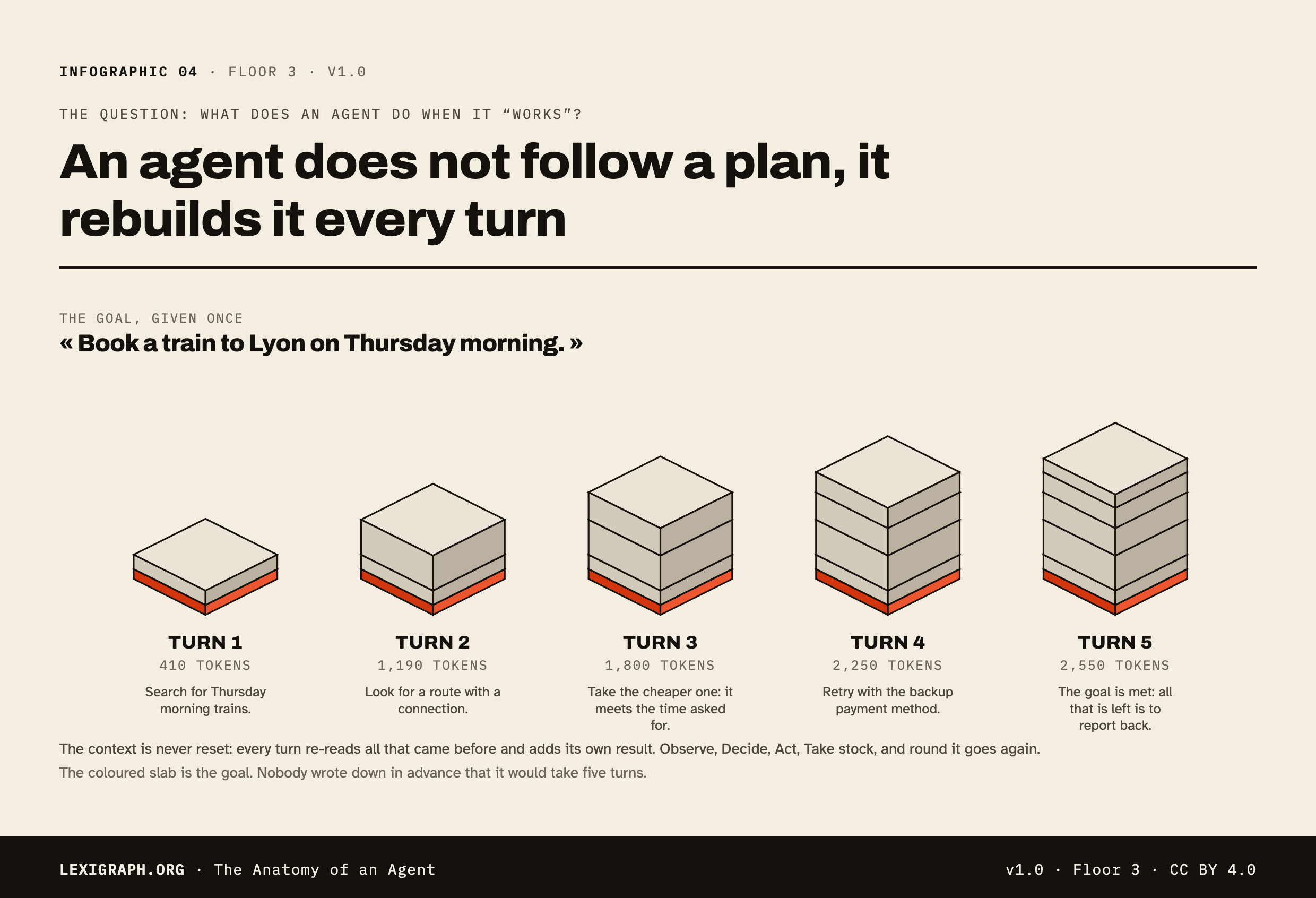
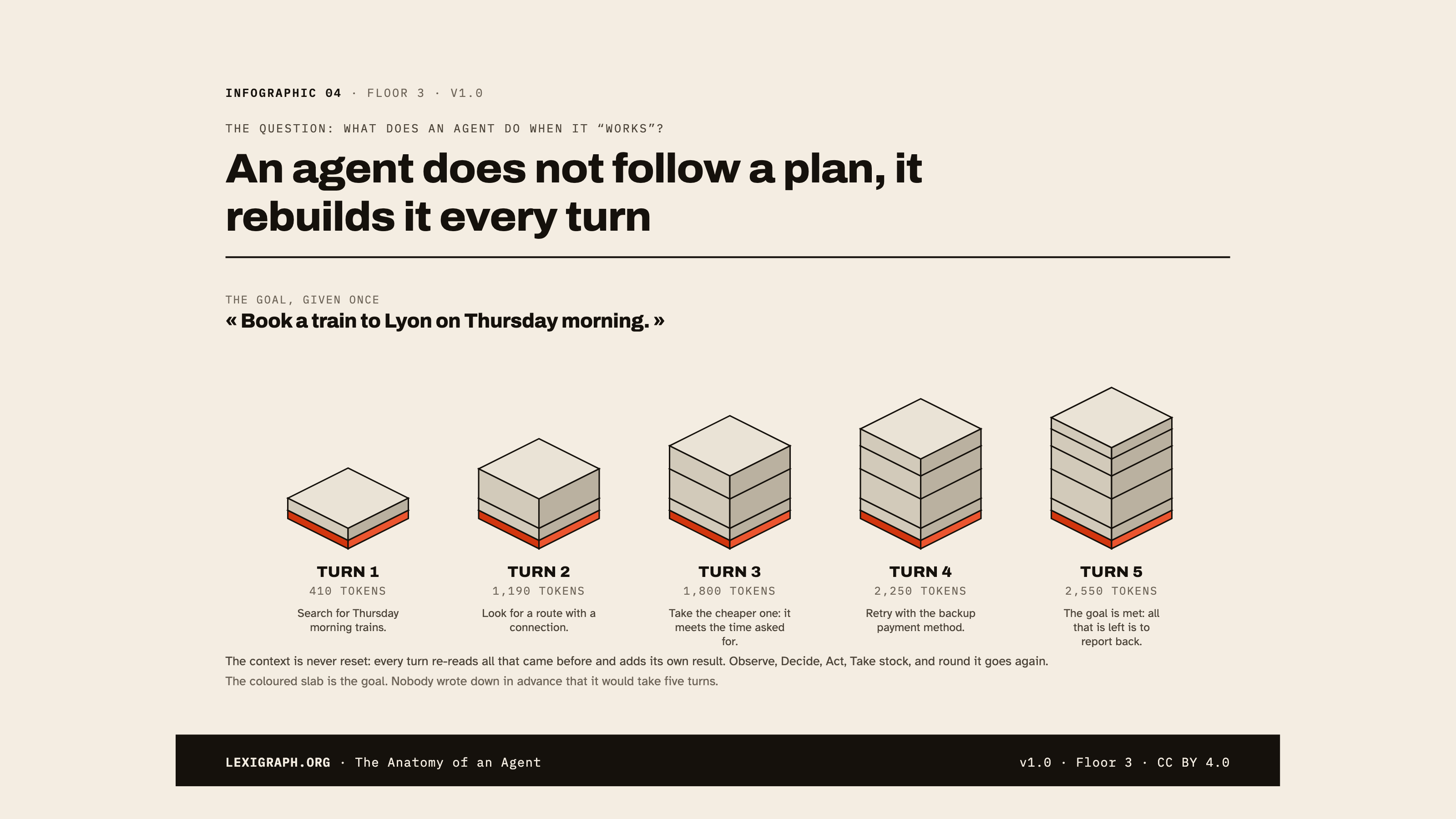
An agent is given a goal, then repeats the same gesture until it gets there: it observes what it knows, decides on the next action, acts through a tool, takes stock of the result. That result becomes an input of the next turn, and the loop starts again.
What is coloured here is the goal: the only thing that does not move. Everything else piles up, turn after turn, and nobody wrote down in advance how many turns it would take.
The goal« Book a train to Lyon on Thursday morning. »It is given once. It does not change on any turn.
The context on turn 1410 tokens, re-read in fullDotted: what the 4 remaining turns will add.
01What the agent does on turn 1turn 1 of 5
- ObserveThe goal, and nothing else.
- DecideSearch for Thursday morning trains.
- ActTimetable search.
- Take stockNo direct train that morning.
What this turn showsThe agent starts from the goal alone. Nothing tells it yet what will have to be done.
What separates an agent from a workflow
Nobody wrote down in advance that it would have to try again with another payment method. In a workflow, that branch would exist in the code, foreseen by a human. Here it is decided on turn 4, by the model, on reading the refusal. That is the whole difference: a workflow is predictable and repeatable, an agent is adaptive and expensive to guarantee.
What it costs
The context is never reset: every turn re-reads everything that came before and adds its own result. The cost of an agent therefore does not grow with the number of turns, it grows faster than that. And reliability compounds: ten steps that are 95 % safe give only about 60 % success end to end.
Glossary terms
Free to reuse with attribution. Poster mode is the printable, shareable version.
Download this infographic
CC BY 4.0Poster mode, as a file. Each one carries its cartouche: the credit to the source travels with the image, and it is the only thing asked in return.
- SVGVector, self-contained, scales without lossA website, an article, a large-format printDownload The Anatomy of an Agent in SVG format
- PNGHigh-resolution image, 2480 px wideA document, teaching material, social mediaDownload The Anatomy of an Agent in PNG format
- PNG 16:9The infographic fitted to a slideA presentationDownload The Anatomy of an Agent in PNG 16:9 format

The SVG embeds its fonts: it opens identically in a browser and in a recent office suite. For a tool that does not read vector files, take the PNG.
Reuse this infographic
CC BY 4.0You can embed this infographic in an article, an intranet or teaching material. It stays interactive, and its cartouche links back here: that is the only thing asked in return.
<iframe src="https://www.lexigraph.org/embed/en/infographic/anatomy-of-an-agent/" title="The Anatomy of an Agent · Lexigraph" width="100%" height="900" loading="lazy" style="border:2px solid #181914"></iframe>Adjust the height to your own layout. For a fixed rendering (print, a slide), use poster mode rather than the embed.